
Issue 01 · K1 Trails
Ethiopia, beyond the legend
Following coffee towards its botanical beginnings, and the stories people tell around it.
K1 Origins · From the quarterly journal
K1 TRAILS / ETHIOPIA
Every familiar object has a point at which it becomes strange again. For coffee, it can be the discovery that the brown beans in the kitchen began as seeds inside a fruit. Or that a crop grown across the tropics has wild relatives living in forests.
Arabica’s natural home includes the humid forests of Ethiopia and neighbouring South Sudan. Kew’s botanical work places particular importance on the forests of south-western Ethiopia, where wild coffee and its genetic diversity remain part of a living landscape. [15]
That is a useful place to begin this trail: with the plant, the forest and the people whose knowledge gives an origin its human meaning.

AN ORIGIN LEGEND
Kaldi and the lively goats
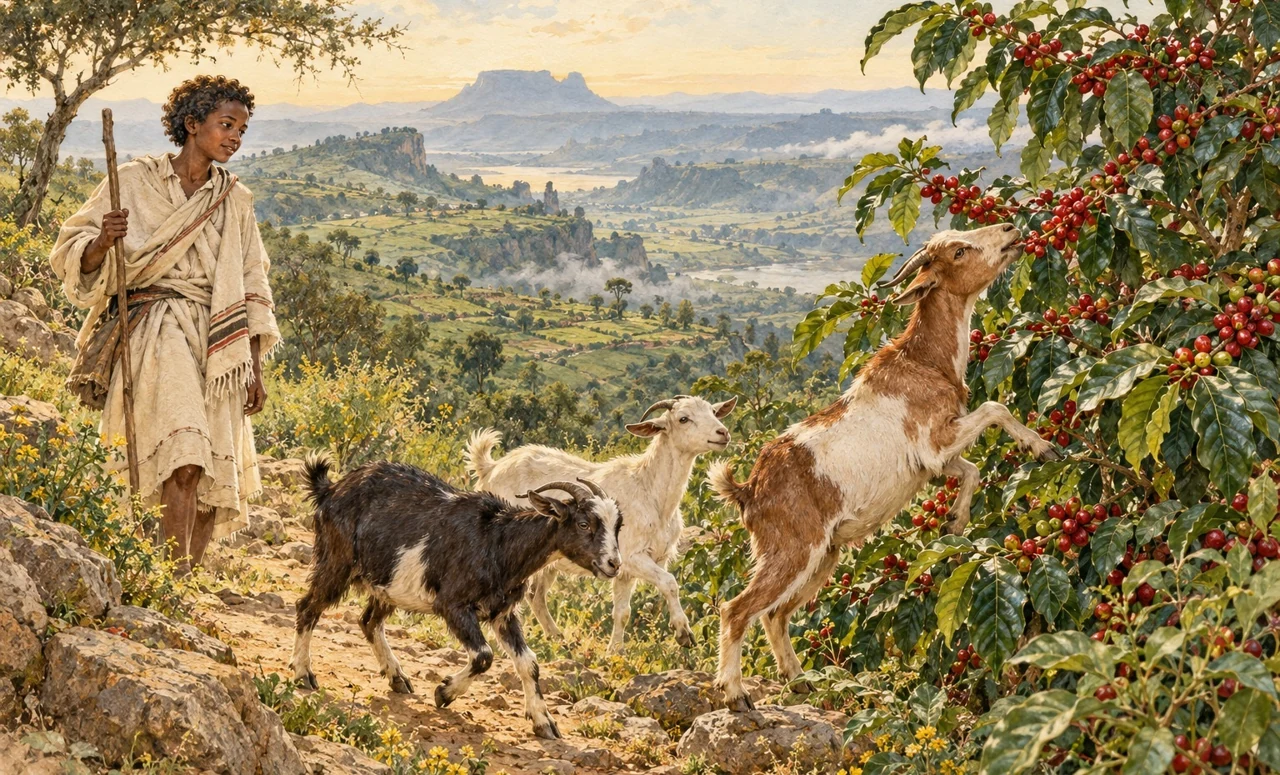
One of coffee’s best-known origin legends tells of an Ethiopian goatherd named Kaldi. In the story, he notices his goats becoming unusually energetic after eating the cherries of a particular tree. His curiosity leads others to discover the stimulating drink. Versions differ in the details and in what happens next. [16]
It is a memorable tale: an observant herder, an unexpected discovery and a little animal mischief. It is also a legend. It cannot establish a discoverer, an exact date or the first recipe for coffee.
We can enjoy it as a story while keeping botanical origins and documented history distinct. Coffee cultivation and trade were established in Yemen by the fifteenth century, an important stage in the drink’s wider journey. [16]
COFFEE AND COMPANY
Time around the coffee
Coffee’s significance in Ethiopia extends well beyond an origin tale. Its preparation and sharing can be an occasion in their own right.
The Smithsonian’s account of coffee ceremonies at DAS Ethiopian restaurant in Washington describes a host preparing the setting and encouraging people to talk and learn about one another. Its collection includes a table used to hold the coffee pot and cups. A useful reminder, perhaps, that the objects around a drink can help create a place for company. [17]
A single account cannot stand for every Ethiopian household or community. Traditions vary, and they deserve to be understood through the people who practise them. For the curious reader, the next step is to listen, read and learn with that openness.
What a trail can teach
The story of coffee is larger than any one bag. It includes plants, journeys, trade and the ways people welcome one another.
At your own table, you might begin by asking a friend how coffee was served in their childhood home. Listen for the small details: the cup, the time of day, who made it and who stayed to talk.
An origin can lead us a long way. Sometimes it also brings us back to the people nearest to us.